Showing posts with label literary annotation. Show all posts

Wednesday, October 2, 2019

Marcus Cain’s Literary Journal Experiment


Here’s a paragraph from my own journal, followed by variations.

September 30, 2019
Today was the start of week 5 for the fall semester. It’s a little rough since my days continue to start at 6am and end around 9:45pm. Throughout the day there are several hills I try to get over throughout the day and the most difficult one today was classes. I kept falling asleep. Oops. It’s probably because I forgot to make lunch – running a little low on energy. I woke up a little while coaching.

Variations:

1.    Chronological Accounts (No Emotions)
-      Today I woke up skipped my workout at the gym because had too much homework for the day before my classes started. I fell asleep in class a lot. That evening I had a great time coaching.

2.    Bullet points (Informal)
-      Start of week 5, fall semester
-      The length of my day
-      Several hills like classes
-      Fell asleep
-      Didn’t make lunch
-      Coaching

3.    Reflection on Greatest Emotions (Singular Thought)
-      The 5thweek of the semester is kind of like the rest, and I beginning to get more tired even though I woke up by the end of the day. 

4.    Descriptive Positivity (Turn Around Event)
-      “Can we blast Taylor Swift and have a dance party?” My kids that I coach on Mondays at 7pm are now my dance party crew. They constantly are high energy and honestly believe that listening to Taylor Swift on full blast gives them powers to practice harder. I have to say, I believe it works. They are constantly dancing around to each station but focus when it is necessary. It’s a whole lot of fun that really gives me energy to get through the last few hours of a 16-hour day.

5.    Reflective Questions (Rhetorical)
-      Is it possible to survive 16-hour days that are on a constant cycle throughout the semester? Why do my days feel like a constant roller coaster, only the hills are high and lows of physical energy? Is falling asleep in class the new study habit I’ve mastered? Is a peanut butter jelly my only source of energy throughout the day? What if I coached all day; would keep me awake longer that sitting in classes? 


Reflection: I like the 4thvariation because it focuses on the positive of the day rather than the negative. What happens throughout your day is usually forgotten if it is negative, so it is important to write down and remember the positive moments. However, I do like variation 2 because it helps me remember what happened that day for reference. I think using alternate approaches is a great way to understand your life through different lenses. There are different ways we can approach life and even more so there are different approaches we can write about life. Experimenting with different variations is a fun way to look at your day in a new way. 
Wednesday, September 18, 2019

Annotations

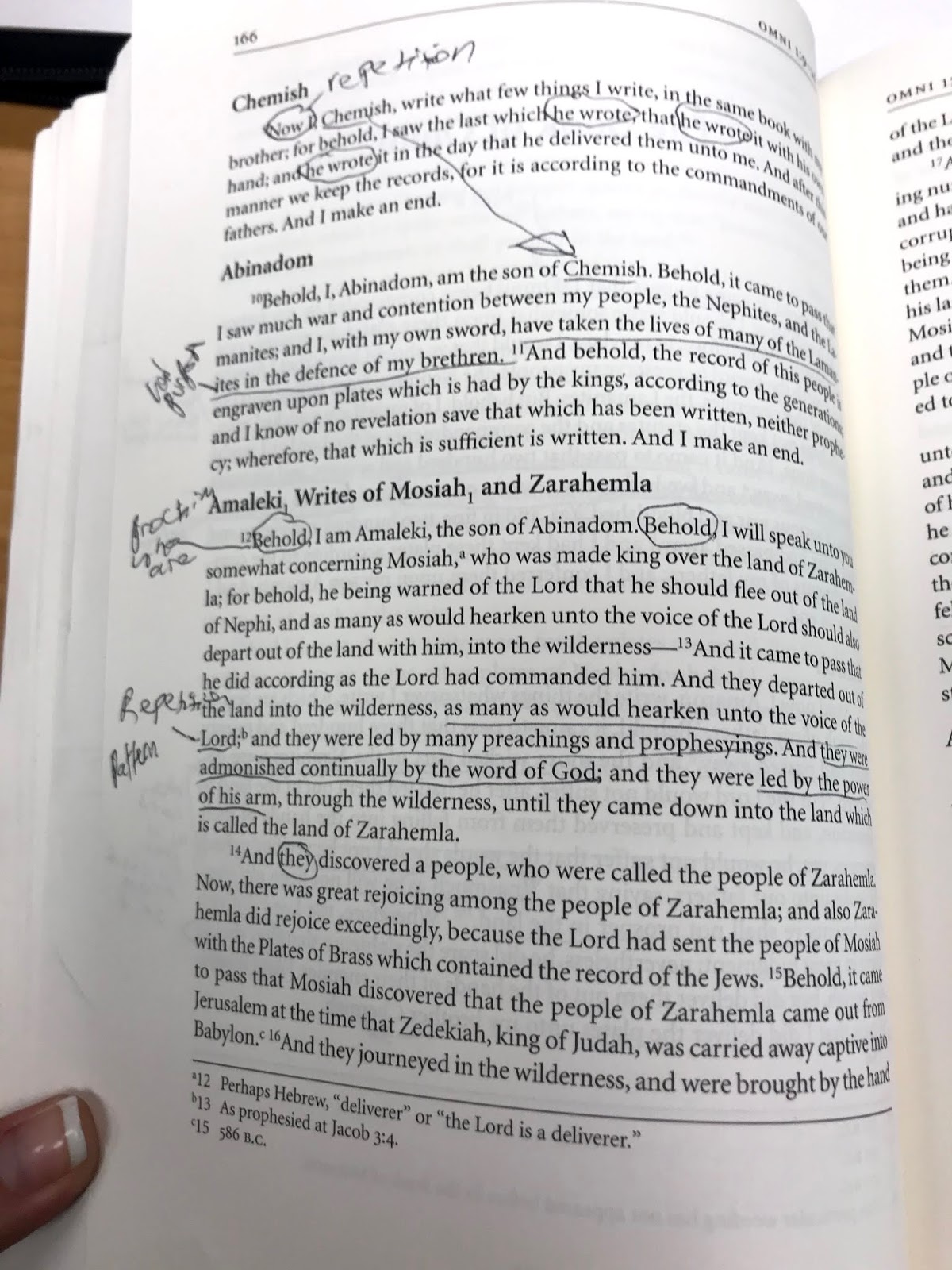
As I was annotating, I noticed specific patterns in how each writer introduces himself. They use similar words as they do that. I think that comes in with the abridgment Moroni did. They write with authority and ethos in that way.

With this pattern of the promises of the Lord when people are wicked and when they are righteous they have consequences. Something else that catches my eye is the reflection of each of the writers. How their mental patterns are. I think its interesting how one of the writers says he fought much to preserve his people but that he is a wicked man. This was curious to me because I think we think harshly of ourselves no matter how much good we do. I know I do that and I've had a problem with that lately. Seeings someone else doing that and recognizing that has really helped me see how that is evident within myself. I guess thats what literature helps us do. Notice patterns of thinking and refining them.

Tuesday, September 17, 2019

Cameron's Annotations of Mosiah 11-12 in the Book of Mormon

When annotating Mosiah 11, in addition to character development, I decided to focus on what the text was trying to tell the audience. Who was the audience? And whose voice is dominating the conversation? As I looked for clues, I realized that the majority of the text is narrated by Mormon and written in the third person. The genre is a combination of the abridgment of Mormon, as he condenses a very long historical record with a didactic narrative approach in explaining what happened, but half way through, the text switches to a journal entry and then to the dialogue. "We and I" become the dominating voice as the people speak and as Abinadi relays the voice of the lord to the "wicked" people. As I looked at themes in describing the kingdom of king Noah, Mormon uses language such as "wicked, whoredomes, abominations, and iniquity" Abinadi uses words such as "repentance, deliverance, and prayer." I hadn't noticed before, but the language regarding a monarchy drastically changes when Mormon is speaking about King Noah in comparison to King Benjamin. Over and over again, Mormon mentions how the people become wicked because of King Noah's corrupt rule. It made me question: what is Mormon trying to teach his audience and to whom does he believe he's speaking to? Could Mormon be suggesting that a monarchy is not the way a people should be ruled, despite the fact that there can be righteous kings as well? And how do social classes form when the people become wicked? How does God view classes in this society? I feel like each element of the text suggested a deeper meaning as I stove to dig a little deeper to find meaning of why Mormon was writing this and to what audience. It feels as though there are innumerable avenues of meaning one can gleam from the literary text of the Book of Mormon.

Buckets' Literary Analysis of the Book of Mormon: Family Matters

There are multiples ways to examine Alma 56, or what Hardy defines as the first and second portion of Helaman's Letters to Moroni. If I could do this over again, I would highlight how the intent of Helaman's letter is transfored from Letter to historical document to scripture, but I decided to analyze Helaman's recollection of "the affairs of the people in that quarter of the land." While Helaman gives an honest, Moroni (and consequently us) learn much more about his "sons".


While many members the Church boast large families, only Helaman had two thousand children, and he was never lucky enough to get a daughter. Though not directly related, Helaman connects his bloodline and theirs together, going back to "our father Lehi." He then makes two different independent validations for calling them sons, first because of their "worthiness" and later on because of their youth. He also centers their purpose for battling around their doubtless maternal obeisance--they were mama's boys. Helaman successfully brings his "family" into battle.

Additionally, while the battle of Antiparah happens, the fallen are less remembered then the remaining. While the highest in command and others die, Helaman keeps the narrative subjective to his own army. It makes sense, but it takes away from the objective account that Mormon suggests Moroni was given when he introduces the letter. Not that Helaman's spin takes away from his accounting, but it does make a history an epic.

Ana's Literary Analysis of the Book of Mormon

For my literary analysis, I decided to focus on 2 Nephi 9. I paid particular attention to the perspective, as it's mostly Jacob bearing his testimony and prophesying (but there are brief moments where the POV shifts to God). I also noticed how different characters (such as Lucifer) were introduced, or different parts of the Plan, as it plays a critical role in 2 Nephi 9. I was taking note of major themes as I annotated as well: remembrance, ordinances/covenants, repentance, avoiding sin, perfection, etc. If I were to do this exercise again, I think I would focus more on the symbolism, and how it is being used in the chapter.

Julie's Literary Annotations of the Book of Mormon


In my annotated reading of 3 Nephi 9–10, I focused on the big contrasts that occurred throughout the chapters such as shifts in tone and Hardy’s choice of formatting (poetry vs. prose, as well as where to break lines). I noted how the theme of justice/God’s righteous anger was immediately superseded by Christ’s love and care. It was interesting to look at this in terms of a generic plot structure, in which Jesus Christ would have be the protagonist and the antagonists could only be all of humankind, since it is human nature to turn away from God (as we could see in the pride cycle leading up to these climactic chapters). Finally, I focused on recurring symbols within the chapters, such as Jesus’s request for the people to become as little children (who would represent humility and obedience) and come to Him.

Katy's Literary Annotations of the Book of Mormon


I chose to annotate 4th Nephi. In my annotations, I focused on the historical nature of the text and the different themes that arose throughout it. I noted main groups of people throughout the text, and the lack of specific characters beyond those keeping the records. I also noted the binaries of wickedness vs. goodness, prosperity vs. poverty, war vs. peace, and true belief vs. hypocrisy. I also noted the interesting gap between the period of prosperity and the period of wickedness. It is almost as if, while abridging this record, Mormon decided it was easier to show people what not to do than what to do.
If I were to do this exercise again, I would focus a bit more on how Mormon's perspective may have influenced the effect of his editing. I would also take more care to note the individual record-keepers.

Monday, September 16, 2019

Assignment: My Literary Annotations of the Book of Mormon

I'm asking my students to analyze the Book of Mormon as literature. For Wednesday, 9/16/19, I'd like each student to annotate the five pages he/she has selected, and then to take a photo of and post the image of one or more pages of that annotation, as I model below.

In preparation, they may wish to review my Primer on Formal Literary Analysis, but the goal is to demonstrate that they can do more than identify themes, or look at the book purely in personal religious ways.

Along with the image or images of their annotations, they should include a capsule explanation or reflection on their experience in doing this annotation, and they should respond to one another's posts, reviewing the other students' approaches to annotation and interpretation.

See my model post below: